Services/ CAE · CFD · FEM

Know the heat and the stress before you cut the mold.

Will the chip throttle? Does the airflow actually reach the fins? Will the snap-fit crack? We simulate your enclosure, heatsink and plastic parts, compare design options side by side, and hand you a report that states the answer first.

01scope

What we simulate.

CFD

Thermal & airflow simulation

Conjugate heat transfer — airflow and solid conduction solved together — to tell you whether the chip overheats and the fan keeps up.

  • Chip / SoC temperature & thermal resistance
  • Vents, ducts and shroud design
  • Heatsink size and orientation
  • Fan P-Q operating point, pressure drop
FEM

Structural analysis

Static FEA with pass/fail against material allowables and a safety factor — strain-based for plastic parts.

  • Snap-fit, spring tab and cantilever strain
  • Brackets, bosses, ribs: stress & deflection
  • Mesh convergence and hand-calc cross-check
  • Assembly force and stiffness estimates
REPORT

Design comparison & report

Several design options compared at once, delivered as a readable report — conclusion first, then validation and limits.

  • Interactive HTML + PDF report
  • Temperature fields, streamlines, strain maps
  • Design advice and a test plan
  • Re-runnable models and scripts
02sample reports

Sample reports.

Three complete studies, published in full. Reports are in Traditional Chinese; English deliverables are available on request.

Raspberry Pi 5 thermal study
CFD · CHT

Raspberry Pi 5 thermal study

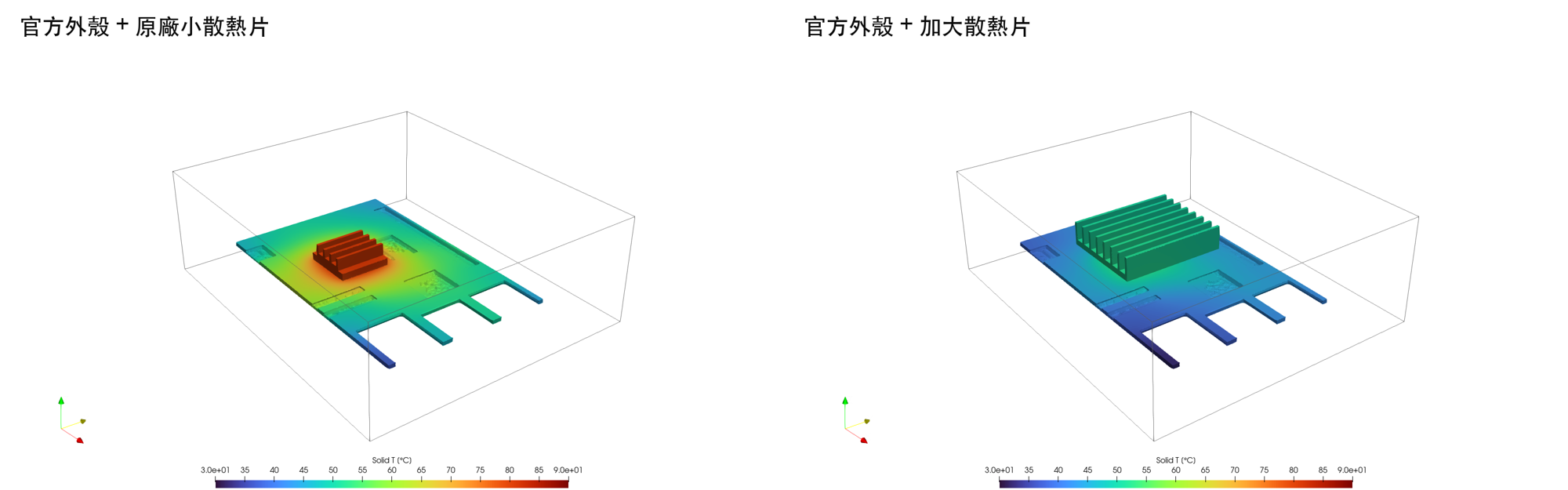
Q · Does the SoC throttle at full load in the official case with the stock heatsink? How much does a larger heatsink buy?

Stock config hits 81.5 ℃, past the threshold; the larger heatsink drops it to 52.6 ℃ at almost no extra fan load. Heat shifts from 76 % via PCB to 74 % via heatsink.

SoC temp
81.5 → 52.6 ℃
Thermal resistance
−51 %
vs. official test
+7.5 ℃ · conservative
FreeCAD · OpenFOAM · ParaView · STEP import
Enclosure airflow & heatsink layout
CFD · CHT

Enclosure airflow & heatsink layout

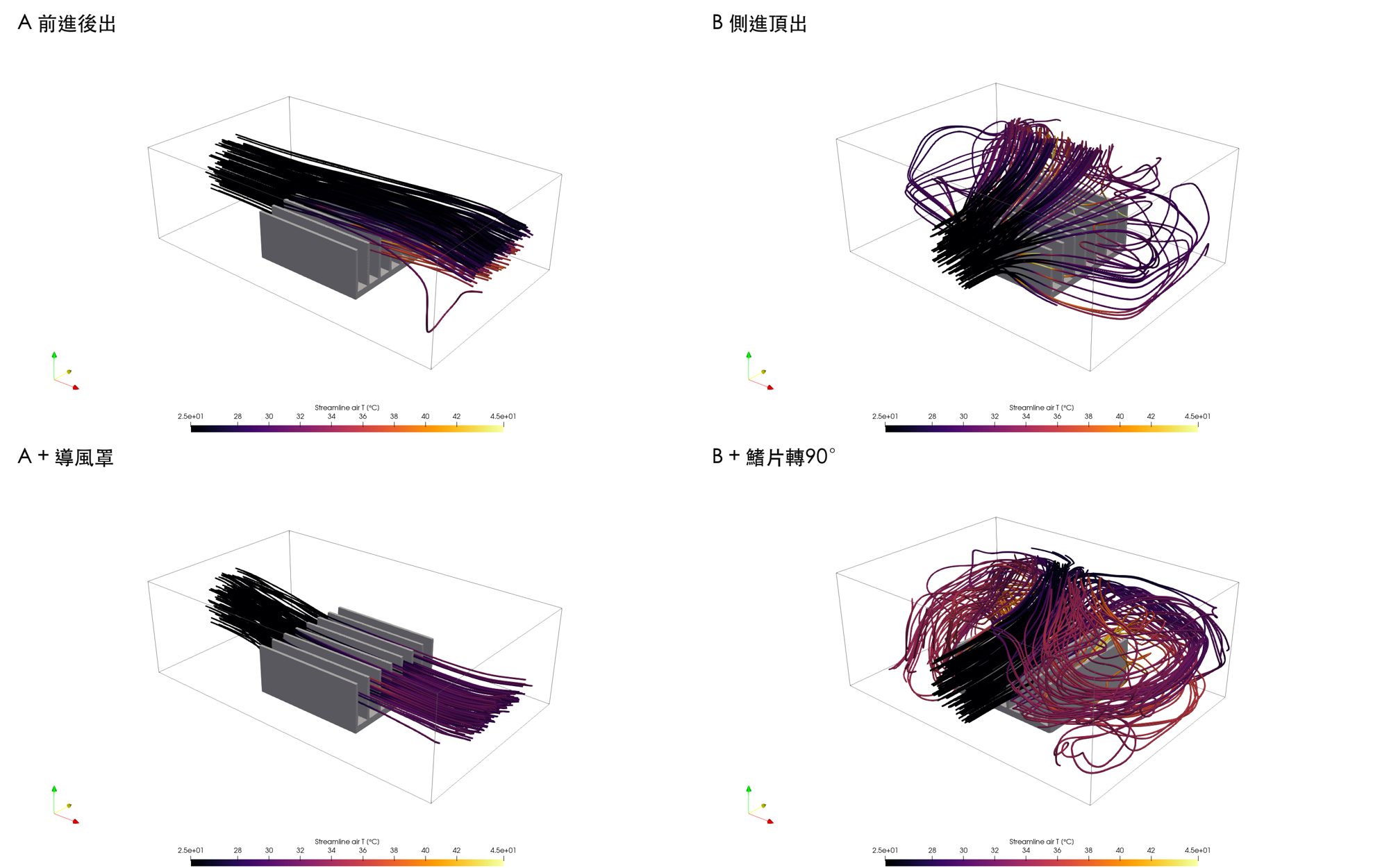
Q · 15 W chip, 40 mm fan — which inlet/outlet and heatsink layout runs coolest? Four layouts compared.

A simple shroud drops the chip from 64.1 ℃ to 50.3 ℃. Over half the original airflow bypassed the fins; side-in/top-out was worst at 83.4 ℃.

Chip temp
−14 ℃
Thermal resistance
1.69 ℃/W
Energy balance
≤ 3 %
FreeCAD · CfdOF · OpenFOAM · ParaView
Snap-fit assembly strain analysis
FEM · Structural

Snap-fit assembly strain analysis

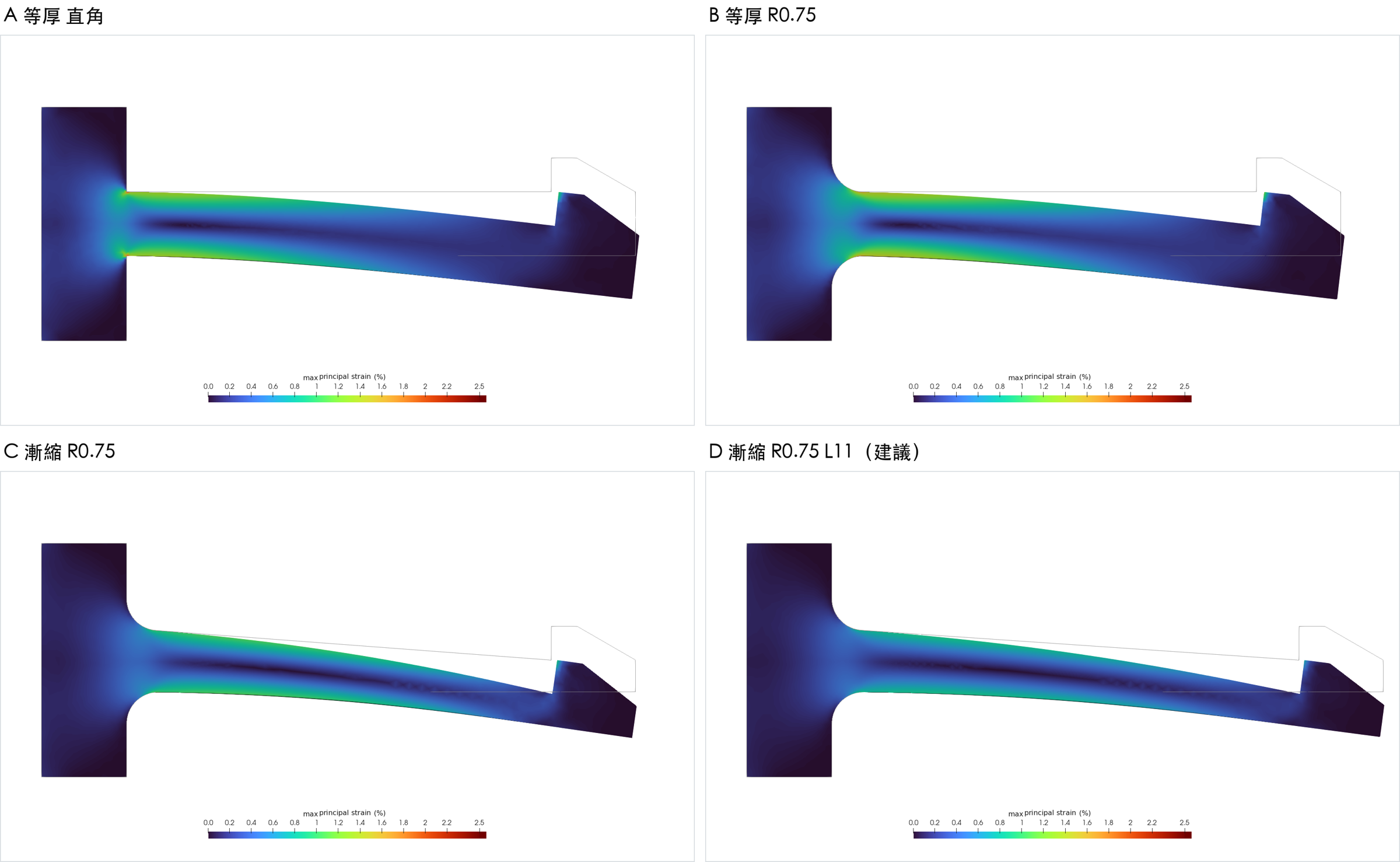
Q · Will a PC/ABS snap-fit crack under repeated assembly? What do fillets, tapering and length each buy?

Sharp-corner and fillet-only designs fail; tapered beam + R0.75 + 11 mm length gives 1.16 % root strain, SF 1.29, 5.3 N assembly force.

Root strain
1.16 %
Safety factor
1.29
Assembly force
5.3 N
FreeCAD · Gmsh · CalculiX · ParaView
03process

How a study runs.

Every number in the report is checked against something independent before it reaches you.

  1. 01

    Define the question

    What must be answered, what counts as a pass (throttle temp, allowable strain), and what is out of scope.

  2. 02

    Model & simplify

    Parametric model from your STEP or drawings, keeping what matters for flow and heat, simplifying the rest.

  3. 03

    Mesh & solve

    Solved with OpenFOAM / CalculiX, design variants run in parallel.

  4. 04

    Validate

    Mesh convergence, energy balance, analytical or hand-calc checks, and published test data where available.

  5. 05

    Report & advise

    Conclusion, comparison, figures, limits and a test plan — in one report.

04faq

Questions.

What do you need from us?

STEP or 2D drawings, materials, power dissipation or loads, and the fan model for thermal work. Incomplete data is fine to start — assumptions are listed in the report.

Does simulation replace physical testing?

No. It compares options before tooling or prototyping so you test fewer variants. Every report lists its assumptions, limits and a recommended test plan.

How long does a study take?

Comparing two to four design options usually takes one to two weeks, depending on geometry and validation needs.

Got something to build?
Let's talk.

First 30-min tech consult is on us. No NDA needed for the kick-off chat — that comes later.